
The first investment I ever made was an individual stock. At that time, there were no apps or online accounts available to make this purchase. Instead, I walked into a local brokerage office, opened an account in person, sat across a desk from a stockbroker and asked him to place the trade. By the time I received the confirmation slip in the mail, roughly half of my money was gone.
What stays with me is not the loss. It is that nobody asked me anything. Nobody asked why I believed that company would do well, what would happen to my plans if I were wrong, or how much of my savings I was prepared to put behind a single idea. The order was placed, the confirmation arrived in the mail, and that was the whole of the advice. I am not certain I would have welcomed those questions at the time, since I was young and overconfident, but I have thought about them for more than thirty years and I have asked many people those same questions.
The reason they still matter is that the conversation itself has never changed. It is hard to get through a dinner or a business event without someone describing a stock they bought years ago that has gone up substantially, and what we rarely hear about is all the other stocks they bought that went nowhere. That is not because anyone is being dishonest. It is simply how memory works. We keep our winners close, we enjoy talking about them, and the disappointments quietly fall out of the story.
The stock name changes. The story never does.
There are good reasons to own stocks. Over long periods they have been one of the most effective ways to grow wealth and protect purchasing power from inflation. So the more interesting question is not whether to own stocks, but how to own them. Should you try to identify a handful of winning companies, or own a broadly diversified pool of them through mutual funds or ETFs? After more than three decades of watching Canadian families succeed and fail at this, my answer is direct: for almost every investor, there is no financial planning reason to own individual stocks. I am not saying you should never own an individual stock. I am saying the decision deserves a good reason. In my experience, most investors have never been asked to supply one.
Why Is Picking Winning Individual Stocks So Difficult?
The challenge is not recognizing great companies after they have succeeded. It is identifying them beforehand, when their future is still uncertain and their share price already reflects everything millions of other investors know and expect.
Research by Arizona State University professor Hendrik Bessembinder shows just how difficult that is. In Do Stocks Outperform Treasury Bills? published in the Journal of Financial Economics, he examined the lifetime returns of every U.S. common stock since 1926 and found that the best-performing 4 percent of listed companies accounted for the entire net wealth creation of the U.S. market above one-month Treasury bills. Slightly more than four out of every seven individual stocks did not even match the return of a Treasury bill over their lifetimes. That deserves a second read, because it means most individual stocks are not merely disappointing. Most individual stocks did worse than holding cash. Nor is this only an American phenomenon. Bessembinder and his co-authors extended the work to more than 64,000 companies worldwide and found the same pattern outside the United States.
The point is not that the stock market is a bad place to be. Over the long run it has rewarded investors generously. The point is that the reward has been concentrated in remarkably few places, which changes what you are actually attempting when you buy a handful of companies. You are not making a modest bet with slightly unfavourable odds. You are trying to locate a very small number of names inside a very large field, in advance, with a share price that already reflects everyone else’s best guess. Bessembinder tested exactly that by simulating single-stock selection repeatedly, and the single-stock strategy underperformed the broad market in 96 percent of those simulations.
So why does anyone keep doing it? Because nothing ever tells them to stop.
You do not have to lose money for stock picking to fail. You only have to earn less than you would have earned by owning the broad market. An investor can make money every single year, comfortably ahead of any fixed income alternative, and still be quietly falling behind the entire time. The statements look fine. There is no line item for the return you did not earn, no alert when the gap widens, and nothing that ever prompts a review. It is the most expensive kind of loss precisely because it never announces itself.
A broadly diversified portfolio removes the guessing. You will own plenty of disappointing companies along the way, but you will also own the small number of extraordinary ones, because you own all of them.
If an Individual Stock I Bought Went Up, Does That Mean It Was a Good Decision?
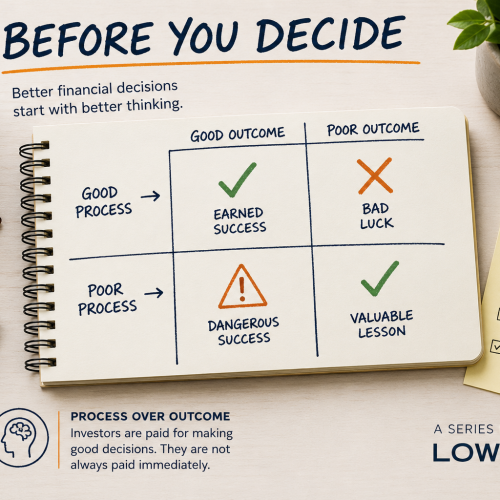
Not on its own, and this is where the first article in this series does the most work. There I made the case that a good decision can produce a bad outcome and a bad decision can produce a good one, and I offered a test for telling skill from luck: could you lose on purpose? In a game of skill you can deliberately play badly and reliably lose. In a game of chance you cannot.
Apply that test to stock picking. If you set out tomorrow to deliberately choose the worst-performing stocks in the market, could you reliably do it? Almost nobody can, and that tells you a great deal about how much skill is actually available in the activity. The answer is the same whether your last pick went up or down. So if you put a significant portion of your portfolio into one company and watched it appreciate, you may well have seen something other investors missed, or you may equally have taken a risk you did not need to take and been lucky enough to have it work out. The return by itself cannot tell you which one happened.
This matters because success changes behaviour. A winning stock reinforces our belief that we have some ability to spot winners, and once we believe that, there is no reason to change what appears to be working. I have watched that sequence more times than I can count, and it almost always runs in the same direction. The winner is rarely the last decision. It is the decision that funds the next, bigger one.
Am I Taking a Risk I Do Not Need to Take?
Concentrating wealth in a few companies introduces company-specific risk, which we call uncompensated risk in investment jargon. In plain English, it is a risk that can largely be diversified away, so there is no reliable reason to expect a higher return simply for bearing it.
Concentrated portfolios can certainly outperform diversified ones, sometimes by a great deal, and that has never been in dispute. The question I would ask is a different one: do you need to take that chance to get where you are going? If a diversified portfolio already gives you a reasonable probability of accomplishing your goals, then any additional risk that could jeopardize them should clear a very high bar. In my experience, very few of them do.
Is a Canadian Portfolio as Diversified as It Looks?
There is a second concentration problem that most Canadian investors never notice, and it sits underneath the first one. The Canadian market is not a balanced market. It is dominated by financial services, meaning the large banks and insurers, and by resources. Rocks and trees, as it is often described. Entire sectors that make up a large share of global markets, including technology, health care and consumer businesses, are only lightly represented here. So a portfolio invested entirely in a Canadian index is already a concentrated bet, even though it holds hundreds of companies and carries the word diversified on the label.
Now add individual stocks on top of that. In my experience, when a Canadian investor holds individual companies, they are very often a bank, a telecom or a pipeline, which means the individual positions concentrate into the same sectors the index already concentrates in. The portfolio looks like it holds many different things. Economically, it holds a few.
Then step back further and look at the whole picture. For most Canadian families, the house, the employment income, the pension and the currency are all Canadian. The family balance sheet is already an enormous and undiversified bet on this one country, and the investment portfolio is the single part of it you can actually spread out. None of this is an argument against owning Canadian companies. It is an argument for knowing what you already own before you concentrate any further.
What If My Employer Is the Individual Stock?
This is the version of concentration I see most often, and it does the most damage precisely because nobody ever decides to create it. Shares arrive through a purchase plan, a bonus paid in equity, restricted share units vesting on a schedule, or options granted years ago and long forgotten. The position builds one vesting date at a time until one day it is the largest holding on the statement.
What makes employer stock different from any other concentrated position is that your exposure is doubled. Your income depends on that company, your benefits depend on it, your pension may depend on it, and now a meaningful part of your savings does as well. If the business runs into serious trouble, none of those things fail independently. The job, the bonus and the share price tend to go at the same time, which is precisely the moment you would most need the savings to still be there.
Canadians have watched this happen. By the summer of 2000, Nortel represented more than a third of the entire Canadian stock market, and thousands of employees held its shares alongside their salaries and their pensions. Within roughly two years the shares had lost more than 99 percent of their value, and the company went on to file for bankruptcy protection in 2009 in the largest corporate failure in Canadian history. Common shareholders were left with nothing. Many of those employees understood the business far better than the average investor did, and it made no difference at all.
The question I ask is a simple one. If your employer paid your next bonus in cash rather than shares, would you take that cash and buy shares in your employer? Asked plainly, most people say no.
What If I Already Own a Lot of One Stock?
For many investors, concentration was never a deliberate decision at all. You inherited shares, or received them at work, or bought a company years ago that did extraordinarily well and now represents a significant portion of your family’s wealth. That makes for a more complicated decision, because selling may trigger capital gains tax, you may feel genuinely attached to the company, and there is always the uncomfortable possibility that you reduce the position only to watch the stock keep climbing.
One question cuts through most of it: if you had the equivalent amount sitting in cash today, would you invest that much of your family’s wealth in this same company? If the answer is no, then you are holding the position for reasons that have nothing to do with your financial plan, and already owning it is not one of those reasons.
That does not mean selling everything tomorrow. Taxes, timing and planning considerations such as lifestyle needs, family gifts or charitable giving all influence how a concentrated position should be unwound. But notice that every one of those is a question about how to diversify. None of them answers the question of how much of your financial future you want riding on the fortunes of one company.
What If I Simply Enjoy Holding Individual Stocks?
Plenty of people enjoy researching individual stocks, and there is nothing wrong with that. If that is you, then set aside a specific amount that will not affect your long-term plan if it goes to zero, decide on that limit before you know whether your picks succeed, and write it down somewhere you will see it. A few early winners will make raising the limit feel entirely reasonable. It is not reasonable. It is the same overconfidence arriving in a better mood.
There is ego in this too, and it is worth naming. A return earned by researching and selecting a successful stock feels more satisfying than the identical return from a boring, diversified fund, because we identified the company, we made the decision, and we were proven right. But as I have written before, there is no degree of difficulty in investing and there are no style points either. You are not paid more because the investment took more research, more conviction or more effort. The market does not care how hard you worked for the return, and if a boring portfolio gives you better odds of accomplishing what matters to you, boring is not a weakness. It is the whole point.
What Should I Ask Myself Before Owning an Individual Stock?
Before buying an individual stock, or before deciding to continue holding a significant position you already own, it is worth sitting with a few questions.
For every buyer there is a seller, so who exactly are you buying these shares from, and what do they know that you do not?
Why do you believe this company will outperform what is already reflected in its share price?
What happens to your financial plan if you turn out to be wrong?
Does your income, your pension or your home already depend on this same company or this same sector?
And how much of your family’s financial future are you willing to make dependent on one business?
Then come back to the question that matters most. Would owning thousands of companies, rather than trying to identify the handful of future winners, still allow you to accomplish everything that matters to you? If the answer is yes, then investing does not need to be any more complicated than that.
Nobody asked me any of these questions in that brokerage office that day, and I have had a long time to consider what it would have been worth if someone had. You do not need to find the next great stock in order to build wealth. You need a portfolio that gives you a reasonable probability of getting where you want to go. Taking risks you do not need to take may well make the journey more interesting. It does not make the destination more likely.
Frequently Asked Questions About Owning Individual Stocks
Is it always a bad idea to own individual stocks?
No. What matters is the role they play in your financial plan and what happens if they perform poorly. A modest position you can afford to lose is a very different thing from having your retirement depend on one or two companies.
Should I sell a stock because it has become a large part of my portfolio?
Not necessarily. A large position creates concentration risk, but taxes and other planning considerations matter as well. A deliberate diversification plan usually makes more sense than treating the decision as all or nothing.
Is a Canadian index fund diversified enough on its own?
It is diversified across companies, but it is concentrated by sector and by country. The Canadian market leans heavily on financial services and resources, and Canada itself is a small share of global markets, so most Canadian investors benefit from holding companies outside Canada as well.
What should I do about shares in the company I work for?
Treat them differently from any other holding, because your income and your savings depend on the same business. A useful test is to ask whether you would buy those shares with cash if they had not been granted to you.
Steve Lowrie is a Portfolio Manager with Aligned Capital Partners Inc. (“ACPI”). The opinions expressed are those of the author and not necessarily those of ACPI. This material is provided for general information, and the opinions expressed and information provided herein are subject to change without notice. Every effort has been made to compile this material from reliable sources; however, no warranty can be made as to its accuracy or completeness. Before acting on the information presented, please seek professional financial advice based on your personal circumstances. ACPI is a full-service investment dealer and a member of the Canadian Investor Protection Fund (“CIPF”) and the Canadian Investment Regulatory Organization (“CIRO”). Investment services are provided through ACPI or Lowrie Investments, an approved trade name of ACPI. Only investment-related products and services are offered through ACPI/Lowrie Investments and are covered by the CIPF.