
Mini, Semi, or Early Retirement: Which Path Fits Your Life (and Wallet)?

After decades of working with clients, I've noticed something interesting: the concept of retirement at 65 has become almost quaint. The reality is that very few people follow that traditional path anymore, and frankly, they shouldn't feel obligated to. Your retirement should reflect your life, not some arbitrary date on a calendar. Retirement isn't a one-size-fits-all event anymore. Instead of that dramatic "last day at the office" moment at 65, most of my clients take one of three very different approaches: mini-retirement (a career intermission to recharge or travel), semi-retirement (scaling back to part-time work while maintaining income and purpose), or early retirement (the complete exit that requires substantial financial preparation). Each path has distinct financial implications, from how much you need to save to when you should start CPP and OAS. The right retirement path isn't just about the numbers, though the numbers certainly matter. It's about matching your financial resources with the life you actually want to live. Whether you're dreaming of a gap year in your 40s, a gradual glide into retirement, or complete freedom in your 50s, understanding the trade-offs and requirements of each path is essential to making a confident decision.

Continue ReadingMini, Semi, or Early Retirement: Which Path Fits Your Life (and Wallet)?

Rethinking Retirement Income

When most people imagine retirement, they picture steady cash flow from their investments to support their lifestyle. The common assumption is that they’ll preserve their financial nest egg and live off the growth—drawing a consistent amount each year while keeping the principal largely intact. But there are actually three broad approaches. At one end, some plan to spend their entire portfolio over their expected lifetime (as one client joked, “I want my last cheque to bounce”). At the other end is the idea of preserving capital entirely. Most people, in practice, end up somewhere in between. But what if that assumption is only part of the story? The reality is that real-life retirement spending isn’t flat. It fluctuates unevenly and unexpectedly over time. And those patterns can have a big impact on your retirement income strategy.

Continue ReadingRethinking Retirement Income

Real Life Investment Strategies #5: Retirement Decumulation Strategies

Steps to Retire the Way You Want: Set Your Retirement Goals, Put Your Money in the Right Places, and Optimize Your Withdrawals Most of us feel young well into our 60s (or even later) and retirement seems like a far away concern for the distant future. However, thinking about your retirement early allows you to comfortably enjoy your later years no matter what your priorities are – leaving a legacy for your loved ones, travelling, spending time on hobbies close to home or any combination. Putting together a retirement income plan early gives you the best path to safeguard your financial freedom post-retirement. Retirement income planning doesn’t mean constant worrying and going without today. It just means taking stock of where you are financially, where you want to be in the future, and setting up a plan to get there. That retirement plan could include setting up the right investment strategies now to allow you the flexibility you’ll need in the future to generate cashflow from the right places and pay the least amount of tax. It also could mean contributing regularly and consistently now so you don’t have to make up for lost ground in the future. Let’s get into what retirement investment vehicles and strategies you have, how to think about your retirement priorities and goals, and how you can plan a decumulation strategy for the retirement you want and deserve...

Continue ReadingReal Life Investment Strategies #5: Retirement Decumulation Strategies

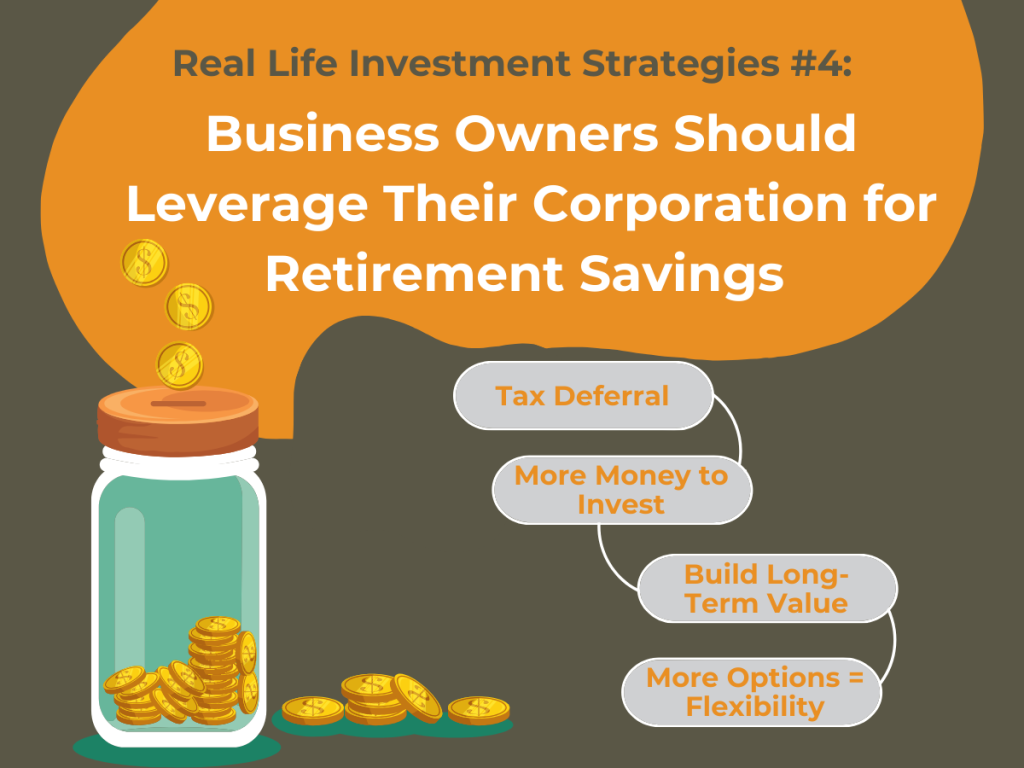
Real Life Investment Strategies #4: Business Owners Should Leverage Their Corporation for Retirement Savings

When you're immersed in running a business, thoughts of saving for retirement often take a backseat, Employees in the corporate world may rely on employer pensions, but as a business owner, the responsibility for your retirement falls squarely on your shoulders. Starting your retirement planning early and consistently contributing allows you to benefit from compounding returns to steadily build your nest egg over time. Investing in your retirement can ensure you have the financial means to enjoy life post-retirement, whether it's traveling, pursuing new passions, passing along a little financial freedom to family members, and more. The best advice I can give you is to step back and view these tax changes versus your long-term financial goals, and to avoid making hasty decisions. If there is major tax reform in the next few years, many individuals might find their hasty planning decisions to be very costly. Even with higher capital gains inclusion rates, investing in your corporation still has many advantages. After reading about the ins-and-outs of using your corporation optimally as a savings and withdrawal vehicle, let’s see it all in action with business owners like you…

Continue ReadingReal Life Investment Strategies #4: Business Owners Should Leverage Their Corporation for Retirement Savings

Real Life Investment Strategies #3: What is the Difference Between a Lifestyle Reserve and an Emergency Fund / Financial Cushion?

Both Emergency Fund and Lifestyle Reserve Planning are Crucial Whether You are Accumulating Wealth or Getting Ready to Retire Having an emergency fund is common advice, whether you are reading this in the financial media or hearing it from a financial advisor. Many people who are later in life and feeling comfortable with their financial situation might disregard this advice, assuming it only applies to those that don’t have as much financial stability. The truth is that an Emergency Fund is something that everyone (even you!) should have. In addition, the added financial security planning of a Lifestyle Reserve should also be part of your financial plan. So, let’s explore exactly what an Emergency Fund is, how a Lifestyle Fund is different, and why both should be in place to ensure long-term financial alternatives and adaptability. Most importantly, I’ll highlight how this applies to Suzie & Trevor Hall (The Accumulators) and Jim & Carol Oates (Almost Ready to be Retirees), so you can see how it can work for you.

Continue ReadingReal Life Investment Strategies #3: What is the Difference Between a Lifestyle Reserve and an Emergency Fund / Financial Cushion?

Real Life Investment Strategies #2: Debunking Retirement Financial “Rules”

Should You Plan Your Retirement Savings According to the 4% Withdrawal Rate Rule or 70% of Pre-Retirement Income Rule? Whether you’re an accumulator or preparing for retirement, how do you plan for saving AND spending your hard-earned cash in retirement? My Answer: It depends. All those popular retirement spending rules you hear about in the popular press or through your favourite financial guru really should be called guidelines. Augmenting blunt estimates with finer-pointed planning may not be as quickly accomplished. But it’s a far more effective way to plan for how much to save as you accumulate wealth, and how much to spend as you withdraw it. In fact, it’s best to consider retirement spending as being a variable process, versus a one-and-done equation. Which is why it depends. LET’S BEND SOME RULES: THE 4% WITHDRAWAL RATE RULE & THE 70% PRE-RETIREMENT INCOME RULE

Continue ReadingReal Life Investment Strategies #2: Debunking Retirement Financial “Rules”